
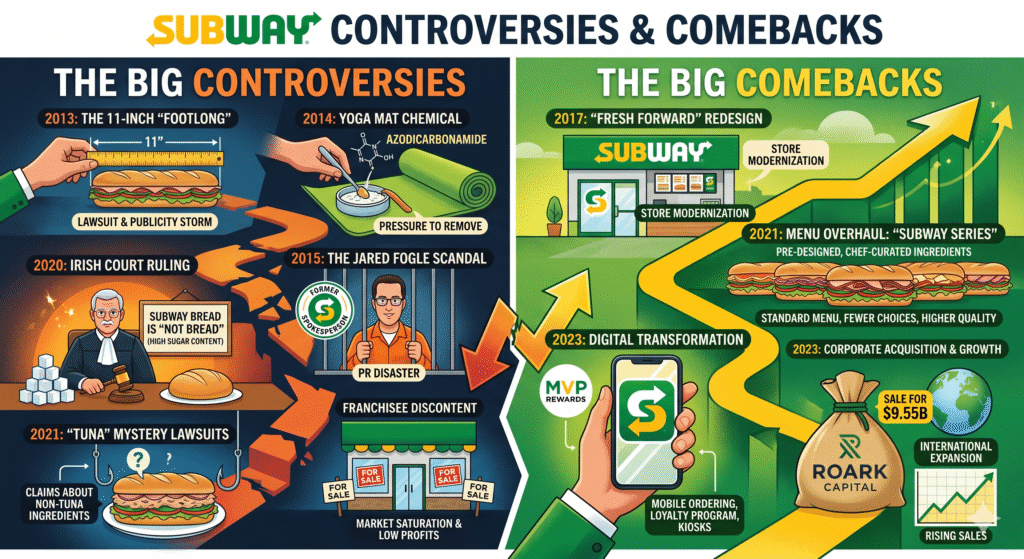
Subway’s biggest controversies and comebacks :From humble beginnings as a single sandwich shop in 1965, Subway grew into the world’s largest restaurant chain, with over 37,000 locations globally. But its journey has been anything but smooth. The brand has weathered scandals that would have sunk lesser companies—from criminal spokespeople to bread that isn’t legally bread—yet somehow, it keeps finding ways back.
Here’s the full story of Subway’s darkest moments and its surprising resilience.
The Jared Fogle Scandal: The Brand’s Greatest Betrayal
For nearly 15 years, Jared Fogle was the face of Subway. The ordinary guy who lost 200 pounds eating Subway sandwiches starred in countless commercials and became synonymous with the brand’s “Eat Fresh” message.
Then came 2015.
Fogle was arrested on charges of possessing child pornography and paying for sex with minors. He pleaded guilty in August 2015. Investigators found some 400 child-porn videos in his possession. He was sentenced to prison.
Subway’s response was notably weak. The chain simply announced on social media that it no longer had a relationship with Fogle and wouldn’t be commenting further. Months later, it was revealed that an internal investigation had uncovered a serious complaint against Fogle made back in 2011—meaning the company may have known about his behavior for years.
The surprising aftermath: Despite the close association between Fogle and Subway, and the heavy publicity of his crimes, researchers consistently failed to detect any effect of the scandal on Subway’s patronage. Some experts question whether Subway had been overestimating Fogle’s impact on sales all along.
“Not Bread”: The Irish Supreme Court Ruling
In 2020, the Republic of Ireland’s Supreme Court dropped a bombshell: Subway’s bread wasn’t legally bread.
Under Ireland’s Value-Added Tax Act of 1972, bread qualifies as a tax-exempt “staple food” only if its sugar content doesn’t exceed 2% of the flour weight. Subway’s bread contains 10% sugar relative to flour—five times the legal limit.
The court ruled that Subway’s bread was more similar to cake for tax purposes. Subway protested, telling the BBC that “Subway’s bread is, of course, bread”. But the Supreme Court had the final word.
The broader context: This wasn’t Subway’s first bread controversy. In 2014, blogger Vani Hari (“FoodBabe”) revealed that Subway’s bread contained azodicarbonamide—a chemical also used in shoe soles and yoga mats. While the FDA considers it safe, it’s banned in the UK and European Union. Subway quickly removed the ingredient.
The Footlong That Wasn’t a Footlong
In 2013, Subway was hit with a class-action lawsuit alleging that its “footlong” sandwiches were actually only 11 inches long.
The controversy went viral. Photos of sub sandwiches next to tape measures flooded social media. Subway insisted it was “committed to ensuring that its six- and 12-inch sandwiches were that length”.
The legal battle dragged on for years. In June 2026, a US appeals court threw out a class action settlement intended to resolve the claims. Subway was sued again in 2024 for allegedly not filling its sandwiches with as much meat as advertised.
The Tuna That Wasn’t Tuna (Or Was It?)
In 2020, a federal class action lawsuit accused Subway of serving a “mysterious non-tuna substance” in its tuna sandwiches. The plaintiffs claimed the tuna was actually a combination of other kinds of fish, pork, chicken, and beef.
The lawsuit became a PR nightmare. Subway launched a dedicated “Tuna Facts” page, declaring that the lawsuit was “meritless” and that the claims “lacked any supporting evidence”.
The outcome: On July 27, 2023, the lawsuit was formally dismissed. Subway serves “100% real, wild-caught tuna,” according to the company. The remaining plaintiff dropped the suit because she was pregnant. But the damage to consumer trust had already been done.
The Sub Club: A Rewards Program Ruined by Fraud
Subway’s original Sub Club loyalty program started in 1985. Customers bought eight subs and got the ninth free.
Then came the fraud. Customers were selling the stamps on eBay. Others were making high-quality counterfeits using improved printers. Employees rarely confronted customers with potentially fraudulent stamps, so franchise owners were giving away free subs.
On June 2, 2005, Subway announced it was dismantling the Sub Club program. Customers were furious, taking to blogs and message boards to complain.
The irony: In December 2025, Subway brought the Sub Club back—only to scrap it again in February 2026 after franchisees complained it would lose too much money.
The $5 Footlong: A Deal That Wouldn’t Die
The $5 Footlong was one of the most successful promotions in fast food history. Introduced nationally in 2008 during the recession, it brought in $3.8 billion in revenue in its first year and bumped Subway into the top 10 of American fast food chains.
But franchisees hated it. They were operating on thin margins, and the discount often meant they made no money at all. The deal was discontinued in 2012.
It returned in 2017 at $4.99. Franchisees signed a petition to eliminate it. It was axed again. It returned in 2020 as a “get two for $10” promotion during COVID—and lasted just two weeks.
The result: A value proposition that once defined the brand became a source of constant conflict between corporate and franchisees.
The Breakfast Menu That Never Took Off
In 2010, Subway required all franchises to open at 7 a.m. and serve breakfast omelet sandwiches.
The problem? People didn’t think of Subway when they thought of breakfast. They thought of McDonald’s Egg McMuffin. In 2018, one poll found that more than 40% of Subway customers weren’t even aware the chain served breakfast.
The breakfast experiment was a costly failure.
Franchisee Wars: The Real Battle
Perhaps Subway’s longest-running controversy has nothing to do with customers—and everything to do with its own franchisees.
Subway grew so fast in the 1980s and ’90s that franchisees complained new locations kept popping up nearby, cannibalizing their business. The chain’s emphasis on promotions made life even harder for operators already operating on thin margins.
In 2025 alone, Subway closed nearly 730 stores in the US. It lost 729 net units across its US franchise system. The chain’s new CEO, Jonathan Fitzpatrick, was brought in to mend fences with “long-disgruntled franchisees”.
Franchisees are pushing back on remodel requirements, arguing the company hasn’t justified the financial investment. They’ve complained that the new Sub Club loyalty program is “financial suicide” because customers can stack discounts and get free subs at a 61% discount.
Subway’s new leadership has its work cut out. “They’re gonna really have to listen to their franchisees… but you’re talking decades of distrust at this point,” said one consultant.
The Comeback: How Subway Is Fighting Back
Despite all this, Subway is staging a remarkable recovery.
The 5-Year Brand Overhaul
In 2020, Subway hired Rodica Titeica as marketing head for Australia and New Zealand with a mandate to revive a “complacent” legacy brand. She set about making “fast changes” to the brand’s creative and media strategy.
The results have been extraordinary:
- Brand recall surged 40%+ annually from 2022 to 2024
- Consideration increased 29%
- Conversation increased 237%
- Five-year compound annual growth hit 41%
- Weekly average restaurant value is up 11.75%
The ‘Eat Fresh, Feel Good’ Reboot
Subway returned to its legacy “Eat Fresh, Feel Good” brand promise. The brand identified the footlong sub and cookies as “unique, ownable assets” that could cut through category sameness.
The strategy has been realized through “fame-building tactics,” including giant sub boats on lakes, a “Cookie-mas” holiday campaign that drove Subway’s best December sub sales ever, and ultra-targeted media buys that tapped lunchtime customers competitors were missing.
Pivoting to Sports
With lunch sales under threat from supermarket meal deals, Subway needed to make itself relevant outside its heartland.
The opportunity lay in sport—specifically, the 2024 summer of sport featuring the Olympics. Instead of competing head-on with McDonald’s official sponsorships, Subway targeted “up and coming” niche sports popular with younger fans. Skateboarding, basketball, and breakdancing—sports that were getting rare spotlight during the Olympics.
The “Fresh Moves” campaign won Gold at The Drum Awards for Marketing.
The Sub Club Revival (and Quick Demise)
In December 2025, Subway brought back the Sub Club loyalty program. Customers could earn a free footlong after purchasing three footlongs.
But franchisees revolted, calling it “financial suicide”. By February 2026, Subway had scrapped the program.
The Bottom Line: A Brand That Refuses to Die
Subway has faced scandals that would have destroyed most brands. A criminal spokesperson. Bread that isn’t legally bread. Sandwiches that aren’t the right length. Tuna that might not be tuna. Angry franchisees. Failed breakfast menus. Loyalty programs ruined by fraud.
Yet Subway keeps coming back.
Between 2022 and 2024, brand recall surged over 40% annually. Sales in Australia and New Zealand have grown at a 41% CAGR over five years. The chain is focusing on better-for-you positioning and shrinking its footprint for long-term growth.
The comeback isn’t complete—sales fell below $9 billion in 2025. Franchisee relations remain tense. But Subway has proven one thing: it’s a brand that knows how to survive.
From a single sandwich shop in 1965 to the world’s largest restaurant chain and back again, Subway’s story is one of resilience. The scandals will keep coming. The franchisees will keep complaining. But the sandwiches will keep selling.
Frequently Asked Questions
Q: What was Subway’s biggest scandal?
The Jared Fogle scandal is widely considered Subway’s biggest controversy. The brand’s longtime spokesperson was arrested in 2015 for child pornography and paying for sex with minors, and Subway’s weak response damaged its reputation.
Q: Did Subway’s bread really get classified as cake?
In 2020, Ireland’s Supreme Court ruled that Subway’s bread couldn’t be legally classified as bread for tax purposes because its sugar content (10%) exceeded the legal limit of 2%. This effectively meant it was more similar to cake under Irish law.
Q: Was the Subway footlong controversy real?
Yes. In 2013, Subway was sued for selling 11-inch sandwiches as “footlongs.” A US appeals court threw out a class action settlement in 2026, and Subway was sued again in 2024 for not filling sandwiches with as much meat as advertised.
Q: Is Subway’s tuna real tuna?
Subway says yes. The company maintains it serves “100% real, wild-caught tuna.” A 2020 class action lawsuit claiming otherwise was dismissed in July 2023.
**Q: Why did Subway get rid of the $5 Footlong?**
Franchisees complained the deal was costing them money. The $5 Footlong was introduced in 2008, discontinued in 2012, briefly revived in 2017 and 2020, but ultimately scrapped due to franchisee opposition.
Q: Is Subway making a comeback?
Yes. Between 2022 and 2024, Subway’s brand recall surged over 40% annually, consideration increased 29%, and five-year CAGR hit 41% in key markets. However, sales still declined in 2025, and franchisee relations remain strained.
Read also
Best Low-Calorie Subway Breads, Ranked
How to Build a Sub Under 400 Calories: The Ultimate Guide to a Guilt-Free Hoagie